
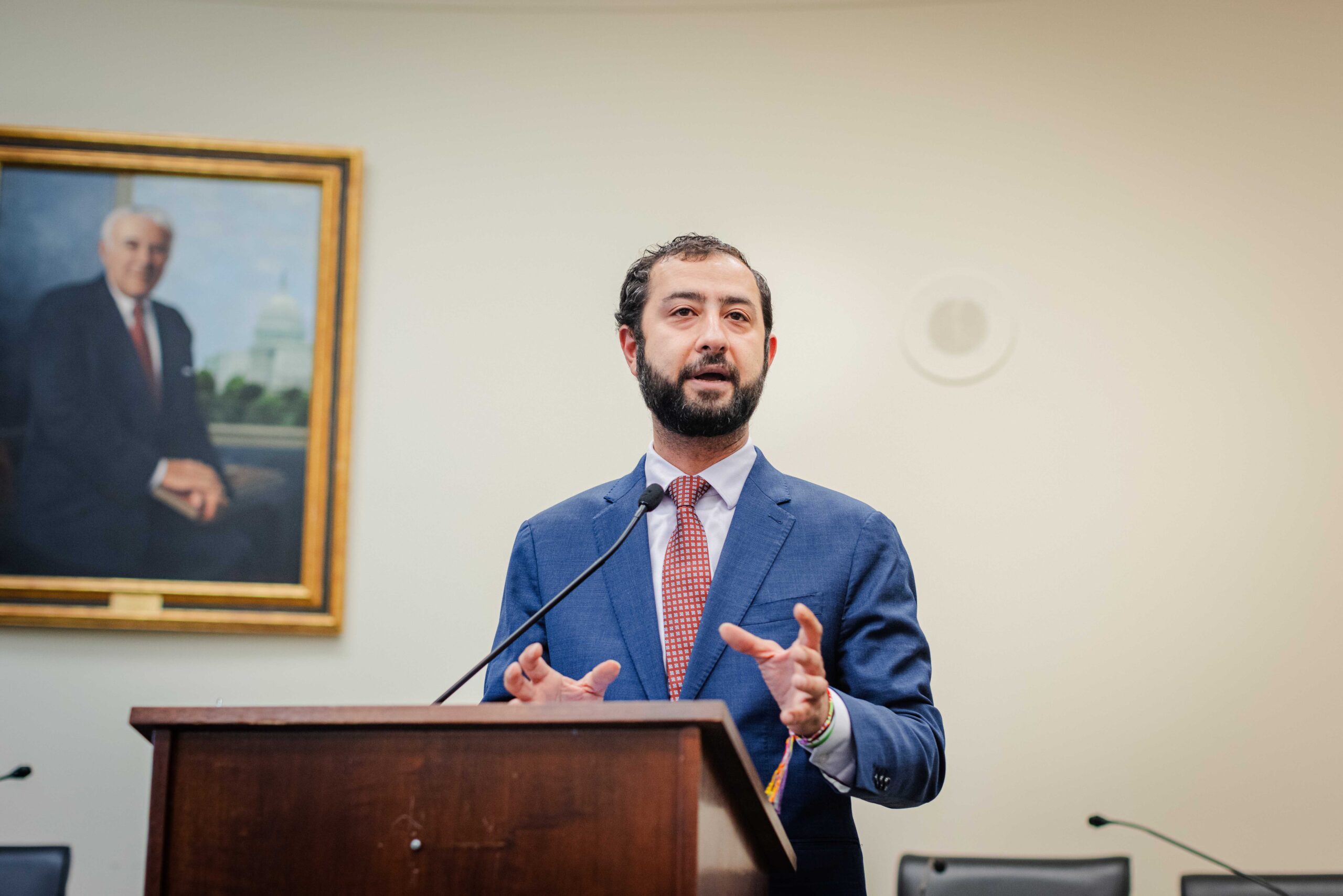

The Biden administration blocked inclusion of the Assad Regime Anti-Normalization Act in the $95 billion foreign aid bill that passed the US Senate on 23 April 2024. To learn more about the lobbying efforts surrounding the Act, Syria in Transition spoke with Mouaz Moustafa, Executive Director for the Syrian Emergency Task Force (SETF.)
Why was the Assad Regime Anti-Normalization Act not included in the foreign aid package that recently passed the Senate?
Moustafa: Things hadn’t started ideally because negotiations between the offices of Senator Risch, a Republican, and Senator Cardin, a Democrat and chairman of the Senate Foreign Relations Committee, hadn’t gone very well. Ultimately, Senator Risch decided to introduce the Anti-Normalization Act on his own, meaning that the introduction wasn’t bipartisan. The foreign aid package was then brought forward by Speaker of the House of Representatives, Mike Johnson, focusing on Israel, Ukraine, and Taiwan. There were negotiations among House leadership, the Speaker’s office, and the administration about adding the Anti-Normalization Act. Unfortunately, the administration and specifically Senator Cardin opposed it. Instead, the second Captagon Act was included as a concession.
What is the way forward then?
Moustafa: If Senator Cardin gets on board, the Anti-Normalization Act is as good as law. It would undergo markup and a vote in the Senate Foreign Relations Committee, meaning that it can be included in the National Defense Authorization Act (NDAA), which would allow us to have it passed before the next Congress. If we don’t get Cardin on board, the House may try to attach it to the NDAA, or it will have to wait till the next Congress. The Caesar Act, for example, passed the House three times before it also passed the Senate and became law.
How do you assess the chances of getting Senator Cardin on board?
Moustafa: Senator Cardin has been supportive of the Syrian cause and may value this legacy as he nears retirement. We are optimistic and open to adjusting the bill while maintaining its core goal. For instance, sections regarding the Arab Gas Pipeline may be modified because actually the Egyptians are too afraid to go through with plans that would benefit Assad after the Anti-Normalization Act passed the House overwhelmingly, and the administration is not going to provide any sort of sanctions waiver on that issue.
Assuming that the administration’s reservations about the Anti-Normalization Act are reflected in Senator Cardin’s position, what are the primary concerns cited?
Moustafa: The administration’s stance seems disingenuous. When the President appointed Brett McGurk as National Security Council Director for MENA, his major direction was to keep Syria off his desk. McGurk made his position about Syria very clear. He wants the US to disengage and the SDF to make a deal with the Assad regime. This kind of talk is ridiculous and unrealistic. I think the only thing that saved a troop withdrawal from Syria was the botched withdrawal from Afghanistan, which caused a lot of headaches for the administration. Both the Obama and Trump administrations were not fantastic on Syria, but at least someone would get on the phone with Abu Dhabi or other countries when they invited Assad. The current administration just advised Arab countries to get something out of normalization. That is a far cry from making clear that uncoordinated normalization would be responded with Caesar sanctions.
Have other stakeholders lobbied against the Anti-Normalization Act?
Moustafa: Arab Gulf countries have made minor lobbying efforts, but the main lobbying against it comes from InterAction, which is a giant umbrella of humanitarian organizations, many of which work in regime areas. InterAction voices concerns about enhanced accountability the Anti-Normalization Act demands from the UN. However, the main issue they have is with sanctions. I don’t know any legislation that involved sanctions that InterAction didn’t lobby against, regardless of the humanitarian exceptions. We are using sanctions because they are some of the only tools we have to counter the Assad regime. These sanctions have been designed by comprehensively taking into account Syrian voices. So this is not an issue of a “Western imperialist power” that is just sanctioning blindly. It is a result of hard work and the demands of the Syrian people.
Despite the humanitarian exceptions, sanctions have unintended consequences. How do you respond to criticism that sanctions hurt ordinary Syrians?
Moustafa: Think back to the earthquake in February 2023. The regime took the opportunity and gleefully claimed that it couldn’t get aid to the victims because of sanctions. In reality, the regime did not even declare northwest Syria a disaster zone and it did not authorize the UN to conduct assessments for over a week while people were dying under the rubble. We negotiated with Turkish authorities at that time to facilitate access of over 35 news outlets, and these journalists witnessed on the ground that sanctions were not the reason people didn’t get help. Another example is the Syrian pound, which had fallen dramatically well before the Caesar Act passed. We should never forget that the economic devastation in Syria is a result of the regime’s actions.
That being said, the Caesar sanctions provide a tone of ability to fix any unintended consequences. We ask people to flag them and let us know because usually things can be quickly fixed by working directly with the Treasury and Congress.
Would you agree that sanctions are justifiable only when combined with proactive conflict management and resolution efforts?
Moustafa: Indeed, there needs to be an overall strategy for Syria. It doesn’t exist due to bad leadership by consecutive administrations on Syria, with the Biden administration frankly being one of the worst. Syria deserves a real US Envoy. There is Goldrich, but the Envoy position has kind of gone despite promises that we received. I remember having a call right after the last election together with an SETF colleague, Sam Hershberger, and Secretary Blinken. Blinken said that Obama’s Syria policy was “a shame” that he would take to his grave, and he promised that in the new administration, Syria would not be on the back burner.
What we have attempted to do through Congress and different arms of the administration, like the DEA, the Department of Justice, and FBI, is to build pressure by having more legal criminal and civil cases against the regime in the US, by highlighting the regime’s role in destabilizing the region, threatening US forces, and bypassing legislations. None of that is a silver bullet. But by making clear that business as usual is no option, we hope to stop the slippery slope of normalization and force the administration to develop a serious strategy.
What are realistic steps that you would like a new administration to take on Syria?
Moustafa: If Trump wins the election, Brett McGurk will no longer be the MENA director at the NSC. That would be a victory for every Syrian that wants democracy in Syria, that doesn’t view themselves as less than others, and that doesn’t consider everyone in the northwest a terrorist and the only partner on the ground to be the PKK-linked leadership of the SDF; and for anyone that understands that it is in the best interest of the Kurds as well that the Assad regime doesn’t just take over as the US pulls out. I would hope for a very aggressive administration when it comes to allies, friends, or enemies, that are normalizing with the Assad regime. The most important step would be to appoint a US Syria Envoy who is credible in showing that the US is back at the table and seriously committed to restarting the political track.